LINGOCUL- THE BRIDGE TO PERSIAN LANGUAGE AND CULTURE

  • Home
  • START HERE
    • SPEAKING TRACK
    • READING TRACK
    • TUTION & PROGRAM FEATURES
    • OUR CURRICULUM
    • TRADITIONAL VS. LINGOCUL
    • MASTERY IN COMPREHENSION
  • ABOUT
    • THE FOUNDER
    • Testimonial
  • RESOURCES
    • FREE LEARNING RESOURCES
    • “LOVE” IN PERSIAN CULTURE
    • PERSIAN HOSPITALITY
    • PERSIAN GREETING
    • PERSIAN OR FARSI—OR BOTH?
    • ONE HISTORY, MANY VIEWS
    • IRAN'S DIVERSE SOCIETY
    • ANCIENT IRAN TO ISLAM
    • REZA SHAH (1925–1941)
    • M. REZA SHAH (1941–1979)
    • 1979 IRANIAN REVOLUTION
    • A WIDER VIEW OF IRAN
  • Contact Us
  • More
    • Home
    • START HERE
      • SPEAKING TRACK
      • READING TRACK
      • TUTION & PROGRAM FEATURES
      • OUR CURRICULUM
      • TRADITIONAL VS. LINGOCUL
      • MASTERY IN COMPREHENSION
    • ABOUT
      • THE FOUNDER
      • Testimonial
    • RESOURCES
      • FREE LEARNING RESOURCES
      • “LOVE” IN PERSIAN CULTURE
      • PERSIAN HOSPITALITY
      • PERSIAN GREETING
      • PERSIAN OR FARSI—OR BOTH?
      • ONE HISTORY, MANY VIEWS
      • IRAN'S DIVERSE SOCIETY
      • ANCIENT IRAN TO ISLAM
      • REZA SHAH (1925–1941)
      • M. REZA SHAH (1941–1979)
      • 1979 IRANIAN REVOLUTION
      • A WIDER VIEW OF IRAN
    • Contact Us

  • Home
  • START HERE
    • SPEAKING TRACK
    • READING TRACK
    • TUTION & PROGRAM FEATURES
    • OUR CURRICULUM
    • TRADITIONAL VS. LINGOCUL
    • MASTERY IN COMPREHENSION
  • ABOUT
    • THE FOUNDER
    • Testimonial
  • RESOURCES
    • FREE LEARNING RESOURCES
    • “LOVE” IN PERSIAN CULTURE
    • PERSIAN HOSPITALITY
    • PERSIAN GREETING
    • PERSIAN OR FARSI—OR BOTH?
    • ONE HISTORY, MANY VIEWS
    • IRAN'S DIVERSE SOCIETY
    • ANCIENT IRAN TO ISLAM
    • REZA SHAH (1925–1941)
    • M. REZA SHAH (1941–1979)
    • 1979 IRANIAN REVOLUTION
    • A WIDER VIEW OF IRAN
  • Contact Us

UNDERSTANDING IRAN BEYOND THE HEADLINES-II

IRANIAN SOCIETY AND ITS DIVERSITY

 📖 INTRODuTION 

Although Iranians share a common history, many cultural traditions, and the official language of Persian (Farsi), they do not all share the same beliefs, values, political views, or ways of life.Understanding these differences is particularly important in Iran, where religion, society, and government have become closely connected through the country's historical and political development.


🕌 RELIGIOUS AND SECULAR PERSPECTIVES

In Iran today, people hold a wide range of views about religion and its role in everyday life and society. Some Iranians are deeply religious and follow Islamic teachings and religious practices in many aspects of their daily lives. Many people within their social circles share similar beliefs and values.

Others do not consider themselves religious or Muslim and believe religion should be a personal matter, preferring a more secular society and government. Many others fall somewhere in between, observing some Islamic traditions and practices while making their own personal choices in other areas of life.

People with different religious views also interact with and maintain relationships across the more religious and more secular segments of Iranian society.


🗺️ ETHNIC AND LINGUISTIC DIVERSITY

Iranian society is also ethnically and linguistically diverse. Although Persian (Farsi) is the country's official language and is spoken throughout Iran, the country is home to several ethnic groups with their own languages, cultural traditions, and deep historical roots.

Persians make up the largest ethnic group and primarily live in the central regions. In the northwest, many Azeris speak Azeri (Azerbaijani Turkic); in the western mountains, many Kurds speak Kurdish; in the southeast, many Baloch speak Balochi; and in parts of southwestern and southern Iran, Arabic is spoken by Arab communities.

In these regions, people often use the languages of their ethnic communities in everyday life, while Persian is taught in schools and serves as the country's common language. Regional television and radio programs are also broadcast in local languages.   


🧩 DIFFERENT IDENTITIES, SHARED TRADITIONS

While these communities have preserved their distinct cultural identities for centuries, they also share a common national history and many cultural traditions. Celebrations such as Nowruz, a shared appreciation for Persian literature and poetry, and centuries of living together have helped connect Iran's diverse communities.

Despite differences in ethnicity, religion, political views, and ways of life, many Iranians share a strong connection to the country's rich cultural heritage. Persian poetry, literature, art, architecture, music, hospitality, family ties, and traditions passed down through generations continue to connect many Iranians.

Poets such as Rumi, Hafez, and Saadi remain an important part of this shared cultural heritage.    

🔍 LOOKING TO THE PAST TO UNDERSTAND THE PRESENT

To better understand how Iranian society became what it is today—and where some of these shared traditions and different perspectives originated—we need to look at the historical and cultural forces that have shaped Iran over centuries.
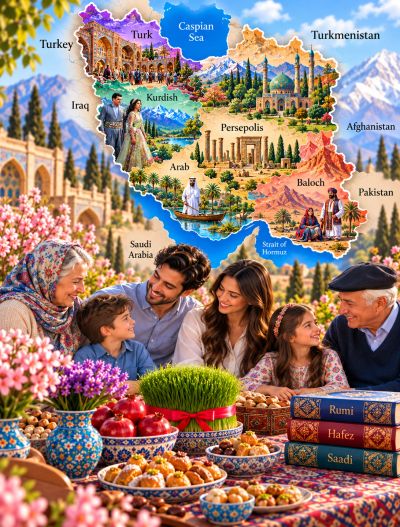
Multi-generational Persian family celebrating with traditional food and map of Iran.

📚 REFERENCES AND FURTHER READING

HISTORICAL SOURCES

  1. Amanat, Abbas. (2017). Iran: A Modern History. Yale University Press.
    https://yalebooks.yale.edu/book/9780300231465/iran/
  2. Encyclopaedia Iranica. “Iranian Languages and Scripts.”
    https://www.iranicaonline.org/articles/iran-vi-iranian-languages-and-scripts/
  3. Windfuhr, Gernot L. (2006). “Non-Iranian Languages in Islamic Iran.” Encyclopaedia Iranica.
    https://www.iranicaonline.org/articles/iran-vii6-in-islamic-iran-language-families/
  4. Boyce, Mary. (2000). “Nowruz: In the Pre-Islamic Period.” Encyclopaedia Iranica.
    https://www.iranicaonline.org/articles/nowruz-i/
  5. Shahbazi, Alireza Shapur. (2000). “Nowruz: In the Islamic Period.” Encyclopaedia Iranica.
    https://www.iranicaonline.org/articles/nowruz-ii/

NEXT IN THE SERIES

In the next blog post, we explore Iran's ancient cultural roots, from the Achaemenid Persian Empire and Zoroastrian traditions to the arrival of Islam, and how ancient Persian heritage and Islamic influences have shaped Iranian culture and traditions over centuries.

CONTINUE READING

Copyright © 2024  All Rights Reserved.

Powered by

This website uses cookies.

We use cookies to analyze website traffic and optimize your website experience. By accepting our use of cookies, your data will be aggregated with all other user data.

Accept